
Or: what is the synodal path?
One thing is certain, it is not the way of Martin Luther.
The Reformation was a religious renewal movement in the 16th century that spanned the whole of Europe. It was led by figures such as the Augustinian monk and professor of theology Martin Luther. He triggered this movement when he spoke out against abusive practices in the church. He wanted to reform the church, i.e. renew it. He did not want to divide the church. Once started, the movement could no longer be stopped.
As a monk, he felt sinful and guilty before God and wanted to be merciful to his heavenly judge. During his Bible studies, he realised that he could not lead a life pleasing to God by his own efforts. According to Luther, no amount of ambitious abstinence or self-torture, no amount of morally superior deeds would lead to a person being righteous before God and certain of their salvation. Instead, a repentant sinner had to trust that God would be merciful to him and therefore judge him righteous.
His stance became known and led to a rift with the party loyal to the Pope within the Church. On 13 June 1525, Martin Luther broke his celibacy and married the former nun Katharina von Bora. The couple lived with their six children, relatives, employees and students in the former Black Monastery in Wittenberg. Luther died in 1546 in his hometown of Eisleben, where he was busy at the time.
Luther’s uprisings against the Catholic Church met with an enthusiastic response from both the lower and higher classes. As the princes of Germany were only too keen to take a stand against the Holy Roman Empire of the German Nation, many lower princes hoped to gain much greater influence with a reformed church than without. The disputes ended after the 30 Years‘ War in the Peace of Westphalia under the motto „Cuius regio, eius religio“. Translated: ‘Whose country, whose religion.’ Of course, country meant the sphere of influence of the respective prince.
Anyone who wonders why I am writing about Luther all the time, even though my topic is actually the Catholic Church, does not understand the fatal influence of the Protestant German Church on the Catholic German Church.
Let’s start with some definitions: Synod
What is a synod? The Synod of the Protestant Church is one of the three governing bodies of the Protestant Church in Germany. The 128 synod members discuss and decide on EKD matters. These include church laws, such as on the budget and data protection, as well as proposals from the Council and the Church Conference. The Synod of the EKD usually meets once a year at different locations for a public meeting lasting several days.
https://www.ekd.de/synode-der-ekd-10772.htm
And this is – purely non-coincidentally – precisely what describes the synodal path of the Catholic bishops in Germany.
Everything that is a problem for German bishops has been tried out as a ‘solution’ in Germany’s Protestant churches:
- Celibacy: that didn’t apply from the beginning, on the contrary. The Protestant pastor’s household was considered the ideal of the German nuclear family
- Introduction of the ordination of women: Elisabeth Haseloff became the first female pastor of a Protestant-Lutheran church in Germany ‘in the sense of the law’ in 1958 in Lübeck for the Evangelical-Lutheran Church in Lübeck. However, until 1974, female pastors in the EKD were required to remain celibate.
- Contraception: The Protestant Church in Germany does not have a ban on pills or contraception.
- Homosexuals: Each Protestant regional church regulates the blessing of same-sex couples for itself. In most regional churches, same-sex and heterosexual couples are on a completely equal footing. Blessing is now possible almost everywhere.
- Remarried couples: When people who have divorced get back together with a partner, this can also be accompanied by a blessing from the church.
These are all issues that are burning under the nails of the German Catholic bishops and which the German Protestant churches have already finalised. You would think that the faithful would just flock to them, that must be THE model for success.
But unfortunately no, unfortunately not at all.
https://fowid.de/meldung/kirchenmitglieder-bundeslaender-2001-2020
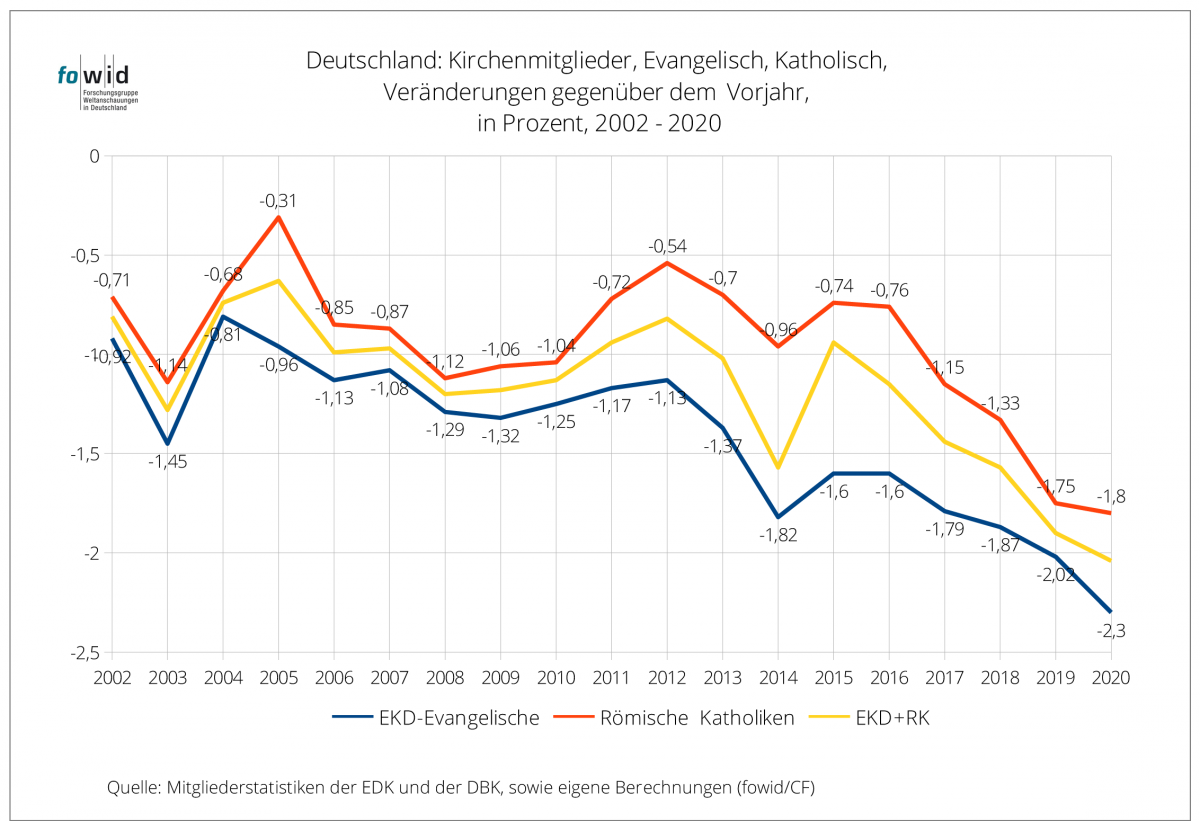
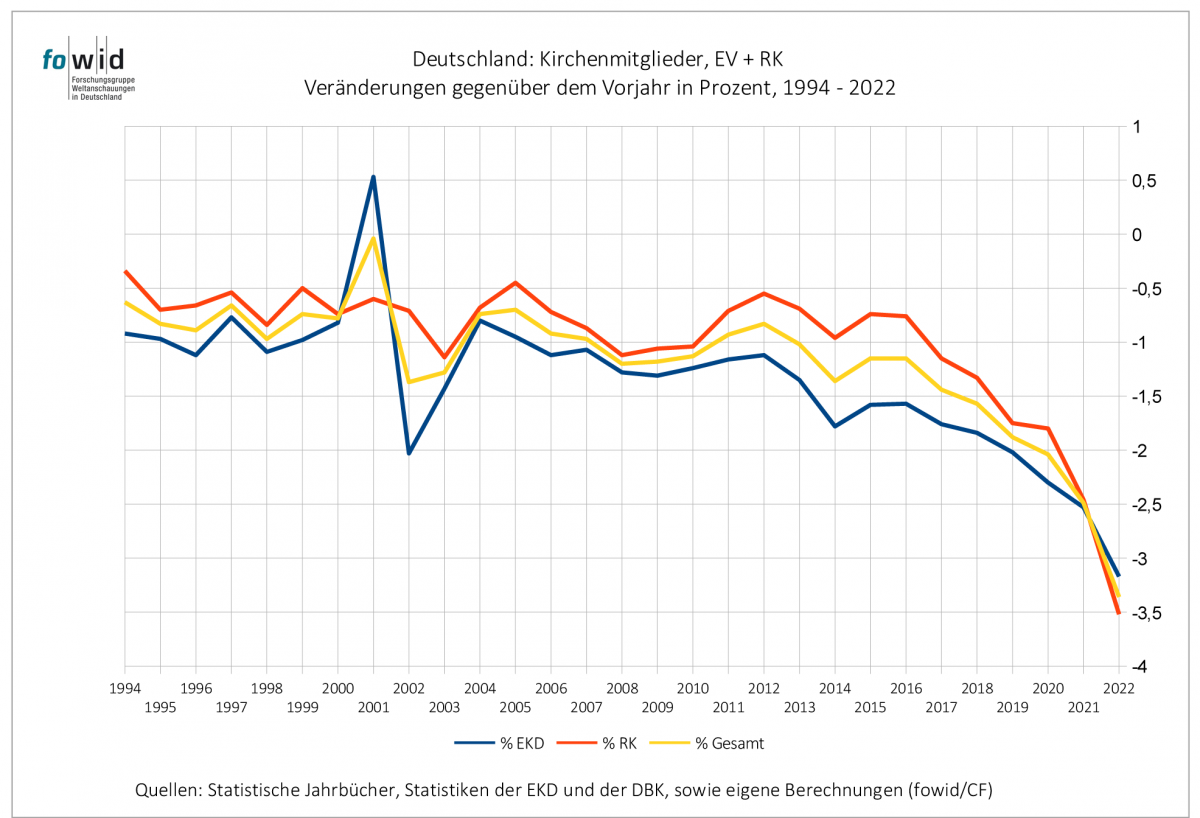
Despite the synodal path, the fall of the Catholic Church in Germany is not exactly that bad, thanks to the influence from Rome, i.e. the papacy.
The heartlessness of the churches reached its peak during the pandemic, when it was decided that unvaccinated women were not allowed to give birth to their children without a mask, dying people were not allowed to receive visits from relatives, and schoolchildren were ‘allowed’ to lift their masks for a minute at so-called air refuelling stations.
Unvaccinated people were not allowed to sit on cushions, they were not allowed to bury their relatives, they were not allowed to receive communion. Not even during the Nazi era were the churches in Germany as cruel as during the Corona period.
Instead, paedophiles and drag queens are now allowed into church-run kindergartens. That’s wonderful, you’re happy to pay church taxes for that, aren’t you?
And so that my Catholic brothers and sisters can get an idea of what people do to pass the time at a Protestant church congress: they paint cunts.
In the Protestant church, it’s all about emphasising some extremely deviant sexuality, which is then celebrated and people think that this makes them the church. Sodom is shit in comparison


 osthollandia